XLW-DG Catheter & Guidewire Friction Tester
The XLW-DG measures the surface sliding performance of medical catheters and guidewires, including hydrophilic-coated devices tested wet. The catheter is clamped between silicone clamp pieces at a set gap, immersed in an integrated thermostatic water bath for the manufacturer-specified soak time, then drawn through the clamp while force is recorded against displacement — the result is the average pull force over the wetted section, from which the coefficient of friction is calculated as pull force divided by clamping force.
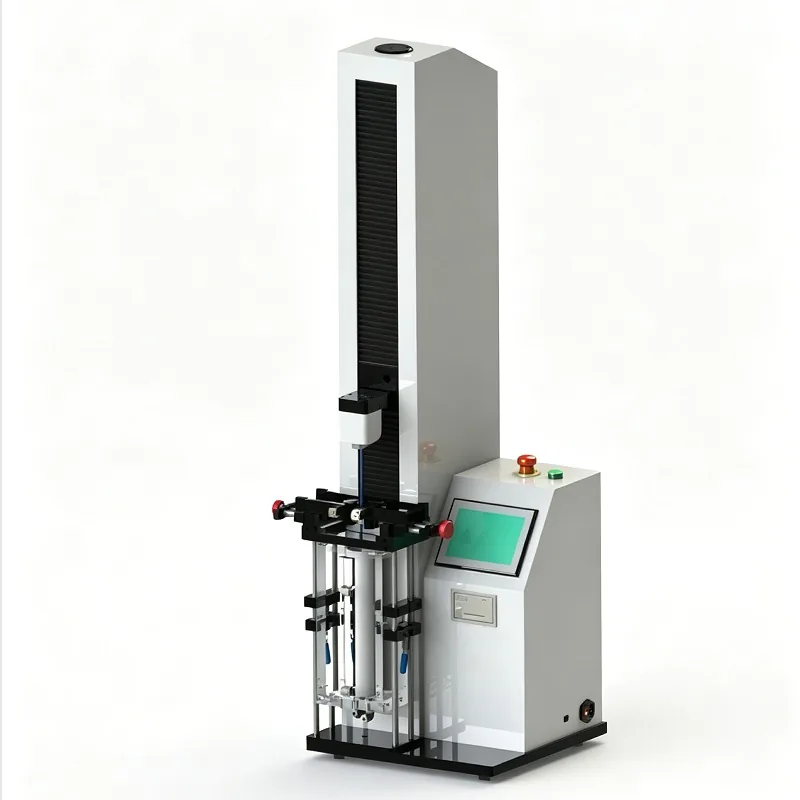
Quick Answer
Choose the XLW-DG when your samples are catheters, guidewires, or other tubular medical devices rather than flat film or sheet — it uses a clamp-and-pull (pinch test) method with an integrated thermostatic water bath, not the slider method the MXD family uses for plastic films and paper. It is built for wet-condition testing of hydrophilic-coated devices and corresponds to the industry's established pinch-test approach for catheter friction, formalized in China by YY/T 1536-2017 and T/CAMDI 021-2019.
Why Catheters and Guidewires Need a Different Test Method
Coefficient of friction testers built around the horizontal sled method — including KHT's own MXD family — measure friction on flat film, sheet, or board samples by dragging a weighted sled across a stationary surface. Catheters and guidewires are round, flexible, and usually coated to be slippery when wet, so the sled method does not apply. The method the industry actually uses for finished catheters and guidewires is a clamp-and-pull design, sometimes called a pinch test: the device is threaded between two clamping pads set to a defined gap and clamping force, wetted or immersed in a fluid at a controlled temperature, then pulled through the clamp at a defined speed while the pulling force is recorded. The coefficient of friction is calculated as the pull force divided by the clamping force. The XLW-DG is built specifically to run this test, with an integrated thermostatic water bath so the sample is genuinely wet and temperature-conditioned during the pull — not tested after it has started to dry.
Thermostatic Water Bath and Clamping System
An integrated thermostatic bath conditions the catheter in situ across a range of -10 to 80°C, held to ±0.1°C, with 10 L/min circulation. The sample is immersed and soaked for the time the manufacturer specifies, then drawn through the clamp so the friction measurement is taken on a fully wetted, temperature-stable surface. Silicone clamp pieces mount in the clamp slots with an adjustable gap set to the required spacing for the device under test, accommodating catheters and guidewires from roughly 12 to 26 Fr (about 4 to 8.7 mm) in outer diameter. Clamping force is adjustable from 0 to 10 N. A cross-centring device holds the sample on the centre line so the load path stays true and results stay repeatable between operators.
Drive, Measurement, and Data
The XLW-DG uses an imported high-precision load cell, a precision ball screw, quality stainless guide rails, and a micro-stepping motor drive, giving force accuracy better than class 0.5 with 0.001 N force resolution and 0.001 mm displacement resolution over a 900 mm test stroke. Test speed is stepless from 0.05 to 600 mm/min, with speed accuracy of ±1% across 1–10 mm/min and ±0.5% across 10–600 mm/min. Force is reported in N, gf, kgf, or lb. A 7-inch color touchscreen displays the live force-displacement curve during the pull. Constant-force and constant-displacement test modes are available in addition to standard travel. The instrument automatically records maximum, minimum, and average pull force for each run, and calculates the coefficient of friction from the average force divided by the clamping force. Results print on a built-in high-speed thermal printer; optional PC software adds bi-directional computer control. A built-in calibration program allows third-party metrology bodies to verify the instrument.
Force Range and Configuration
Force range is selected at order time from 10 N, 50 N, 100 N, or 300 N — one or more sensors can be specified. The 10 N sensor is the recommended standard configuration for hydrophilic-coated catheter and guidewire testing, where pull forces typically fall well under 1 N once wetted; the higher ranges suit stiffer or uncoated samples, or applications outside routine coated-device QC. Only official standard configurations are listed here — confirm any non-standard sensor range with KHT before ordering. Standard configuration includes the main unit, thermostatic water-bath system, clamping system, custom fixtures, power cord, printer paper, fuse, calibration certificate, warranty card, and operation manual. Optional PC software (bi-directional) and a computer can be added. Power supply is AC 220 V, 50 Hz. Overall dimensions are 480 × 560 × 1430 mm (L × W × H) at approximately 90 kg net weight.
Standards and How the XLW-DG Corresponds to the Pinch Test
ISO and ASTM do not currently publish a method standard specifically for finished-catheter or finished-guidewire surface friction. ISO 8295 and ASTM D1894 — the standards labs commonly cite when discussing catheter coating friction — are film and sheeting slider methods; they are widely adapted by the coating industry for flat, dry test coupons cut from coating material, but they do not describe a wet, tubular-device pinch test. Two China-published documents fill this gap and are the standards the XLW-DG is built to run: YY/T 1536-2017, a standard test model for evaluating the surface sliding performance of non-vascular catheters, and T/CAMDI 021-2019, a specification for single-use hydrophilic-coated guidewires that defines a repeatable pinch-test method (37 ± 2°C, defined clamping force and speed) with a stated pass/fail friction-force limit. The XLW-DG's clamp-gap, clamping-force, thermostatic-bath, and pull-speed design maps one-to-one onto the pinch test as it is run industry-wide: two defined clamping surfaces, a defined clamping force, a defined fluid and temperature, and a defined pull speed, with the coefficient of friction calculated as pull force divided by clamping force. Labs that must also report ISO 8295 / ASTM D1894 film-coupon data on the raw coating material can pair the XLW-DG with a KHT MXD-series slider tester (MXD-02A or MXD-02) for that separate test.
Frequently Asked Questions
Testing Catheters or Guidewires for Friction?
Tell us your device's outer diameter, coating type, and target force range — we respond within 24 hours with configuration guidance.